Following our class discussion, I decided to update my post by adding a flowchart and focusing on the formulation and implementation of the policy:
Justifying the quote on the homepage, this post focuses on the UAE National Agenda in education, which was launched by Vice President Muhammad bin Raschid Al Maktum in 2014 and is being updated for 2021. In short, the goal of these policies is to improve the performance of students in the UAE, which “will require a complete transformation of the current education system and teaching methods.” One such change is the modernization of schools into “smart” schools that provide teachers and students the technological support for better learning. Among the goals of the National Agenda are:
- Rank among the 20 highest performing countries in PISA
- Ensure that 90% of Emirati students complete high school education
- Ensure that 100% of schools have high-quality teachers
The significance the government places on this education transformation can be viewed through the percentage of the federal budget allocated to education; from 13.44% in 2016 to 20.23% in 2018. In 2019 the figure has dropped to 16.8%, though even then it is comparably high compared to other countries. For reference, Germany spends a little below 5% on education.
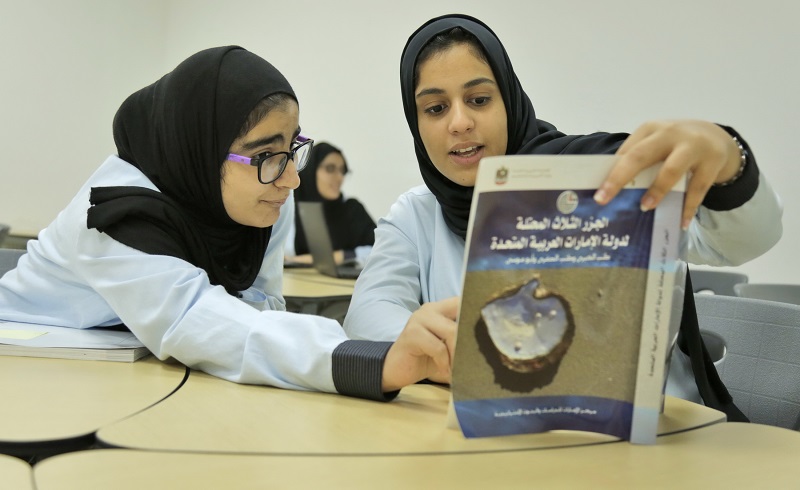
The formulation and implementation of the national program in education was done through consultation with both local and foreign consultants, a practice that was met with criticism in the past. This program is partially based on international systems; critics claim that reforms should emphasize a unique Emirati character. The international character of the reforms is also seen through the government’s offering of scholarships for students to study abroad and gain international experience.
According to the government’s website, the agenda was developed with the help of 300 officials from 90 government entities and covers various sectors such as the economy, education and healthcare. The process of developing and formulating the National Agenda on education has not been very transparent, though I was able to gather bits and pieces of information to establish a very basic flowchart of that process. Because the program was announced by the vice president, I believe that the Federal Supreme Council (FSC) set the broad goals of the agenda. In the next step, the Ministry of Education established and published the actual policy framework that ought to achieve these goals. This framework “is a reference book for those who work and have interests in Education.”
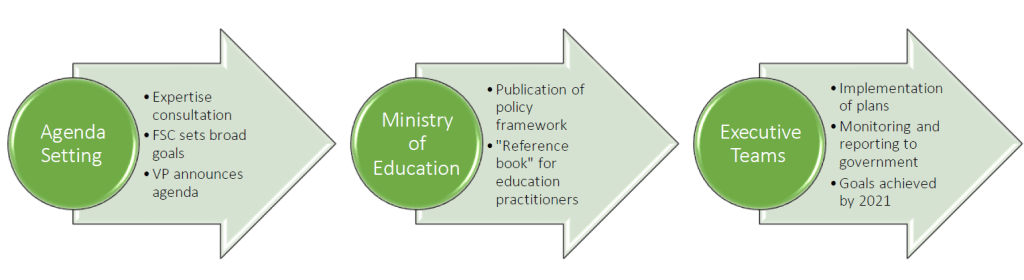
The Vice President launched 36 executive teams consisted of 500 officials in order to oversee and accelerate the implementation of the UAE National Agenda. Their work is done through work plans that comprise of annually updated short, medium and long term initiatives to achieve the National Agenda targets.
Thus, this is clearly an example of top-down policy making, in which a general goal in various fields is set and the “system” is given seven years to achieve these goals, coinciding with the UAE’s 50th National Day. To my humble knowledge, such top-down long-term policies are “easier” to implement in non-democracies, as the incumbent government can allow itself investments that are not influenced by the goal of being re-elected. This is not necessarily a negative aspect; while I am fully aware that this post relies mainly on government sources that might be biased, the UAE National Agenda has proven to be a success. In sum, this example shows how the UAE government does use expert help in implementing the steps necessary to achieve its long-term goals; however, these goals are formulated from “above,” showing how powerful the FSC is.

