This week’s post concerns propaganda in the United Arab Emirates. It’s important to note that the term “propaganda” is not used in its negative connotation, but rather in a neutral way, as done in Esarey et al.’s “Support for Propaganda.”[1] Propaganda is viewed as a form of communication among the regime and the citizens with the aim of “guiding their thoughts and actions and increasing public support of the regime’s leadership, policies and ideology” (p. 102).
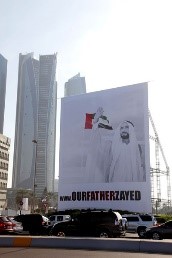
Scholar Lisa Wedeen uses the example of President Asad to show how the use of familial metaphors is an attempt to create a national narrative that promotes public obedience in Syria under the paternal authority of Asad (p. 54).[2] Similar conclusions could be drawn about the UAE; its leader Sheikh Zayed is often portrayed as a fatherly figure, which aids in the construction of a national family, led by a figure that can be trusted to look after the nation. The huge poster included above clearly establishes this father figure of Sheikh Zayed: he is powerful and authoritative, but also cares for the nation. Especially in the case of the UAE, which is a union of seven emirates, creating this sense of family under one leader is important in order to ensure adherence to the regime. In addition, this poster does not depict any violent or militant images, as we often see in non-democratic states, where leaders project their power with parades or images promoting their masculinity or physical might. Therefore, this propaganda gives a more calming and caring connotation to the father of the UAE. This may be especially important, given that the vast majority of UAE residents are not UAE citizens.
In addition, one common theme in the Middle East is to refer to the land as the mother (in Arabic, Umm = mother, Umma = nation). In that spirit, this year’s Emirati Women’s Day carries the slogan “Preparing for the next fifty years: Women are the support of the nation.” The focus on both the “father” and the “mother” of the nation signify how familial symbols play an important role in the UAE’s construction of the Emirati nation. This approach is clearly more traditional, though at the same time it can be viewed as progressive, as women do take on a significant role in the national identity of the UAE.
In contrast, a modern and progressive image can be seen in the UAE’s attempt outwardly to present itself as such by sponsoring various football clubs (e.g. Real Madrid and Paris Saint German). The following clips present this “modern” image of the UAE, which appears successful, as more organizations cooperate with Emirates, the state-owned airline:
While it may be easy to view these advertisements as purely for entertainment and economic purposes, with this broader definition of propaganda, they must be classified as such.
As I’ve shown, propaganda in the UAE is not purely about submission, but rather has a goal of uniting the nation and presenting a positive view of the Emirates abroad.
[1] Ashley Esarey, Daniela Stockmann & Jie Zhang (2017) Support for Propaganda: Chinese perceptions of public service advertising, Journal of Contemporary China, 26:103, 101-117, DOI: 10.1080/10670564.2016.1206282
[2] Wedeen, Lisa (1999). Ambiguities of Domination: Politics, Rhetoric, and Symbols in Contemporary Syria. Chicago: University of Chicago Press. Chapters 2 and 3: pp. 32-86.


You decided to not choose one piece of propaganda but several ones. Your blogpost includes a poster with UAE leader Sheikh Zayed, two Emirates Airlines promotional videos and a slogan for Emirati Women’s Day. The blogpost respects the word limit of 500 words.
— The Choice —
The poster and the slogan are very conventional and simple methods of propaganda. This is a sound and justified choice as these pieces are probably very present in the lives of UAE citizens and residents. I would assume that they are the most straightforward way of government propaganda in the UAE because of their simplicity. Thus, it should make clear what it is that the government wants to transmit to its people. This already warrants a deeper examination and analysis – more than would be the case with something more “original”.
The promotional videos of Emirates Airlines are a bit more unconventional. They might not immediately pop into people’s heads when they think “propaganda”. Airlines seem commercial, hence, non-governmental. But, as you have pointed out, EA is a government-owned company. Thus, it makes sense to look into its PR and check for governmental propaganda endeavors. You clearly point out that the UAE is trying to depict an image of “modernity” to the outside world of potential tourists, businessmen and expats. This is a contrast to what the more traditional forms of propaganda try to convey. That is precisely why I find this choice interesting: It allows for a comparison between the government’s internal and external communication strategies.
— The Analysis —
You proceed in your blogpost by describing the pieces of propaganda briefly and explain what they try to convey. By describing the narrative that the government tries to transmit, you refer to dynamics examined by Wedeen (1999). You identify the parallels between methods and narratives of propaganda in Syria and the UAE. This shows that you understood the key points of Wedeen’s text and are able to spot them in other cases.
The blogpost would benefit a lot from clarifying the argument and making your assessment of the propaganda’s effectiveness more explicit. You chose to include different pieces of propaganda which is already more demanding than focusing on one. As I see it, you should either focus on one piece of propaganda and analyze it thoroughly or analyze the different pieces comparatively. I already mentioned above that I would love a comparative approach because a) you already started with initial, intriguing thoughts and developments, hence, you are only missing a stylistic “red line” and b) such an approach promises profound insights on the UAE’s overall propaganda strategy. You already noted that they differ and how. You would need to further answer questions such as: Why do they differ? Are those different propaganda elements addressing different people? Which people? What might be the intention of the government to go for a coherent or incoherent approach? You do suggest to an extent that propaganda changes depending on the audience. Yet, you did not explore this further, which I would encourage. You already pointed out that the different propaganda pieces convey different narratives. To create room for your own argument and assessment of the propaganda strategy, I would suggest to shorten your descriptive parts and your discussion of Wedeen’s text. There is potential to save some words without losing the key insights.
LikeLike